
The State of Wholesale Finance 2026
Days' supply, cost of carry and collateral risk across six asset classes, from eight months of public data. Twenty-two figures, seven exhibits, every source named.
Supply came back into balance in 2026. The cost of carrying it did not, and the risk moved from the balance sheet to the lot. This edition reads eight months of public data across auto, powersports and marine, RV, equipment, agriculture and heavy truck, and comes to five findings.
1. Supply normalized. Carry did not.
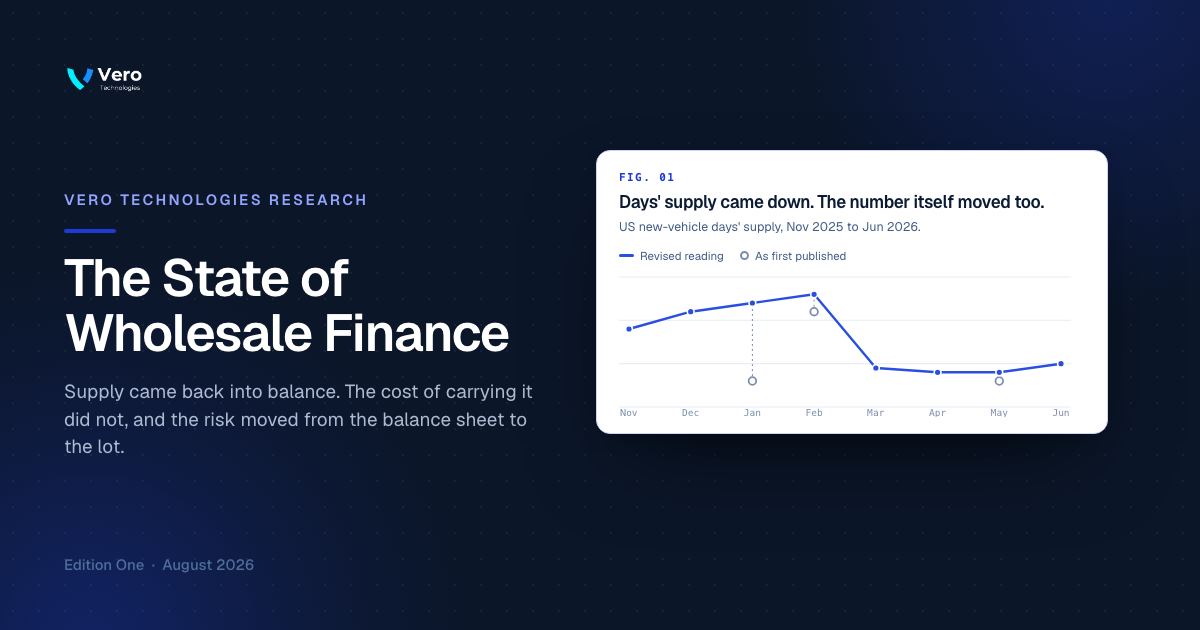
New-vehicle days' supply peaked at a revised 96 in February and settled into the high seventies by summer. The financing underneath it did not follow. Floor plan is priced off a SOFR near 3.6 percent with prime at 6.75, and dealers reported net floor plan expense per unit rising roughly 39 percent year over year in a single 2025 quarter. Fewer units on the lot, more cost per unit on the line.
2. The metric your covenants reference gets revised.
January was first published at 76 days and later revised to 94. Days' supply is a ratio whose denominator is estimated before it is known, so a soft sales month ages every unit on every lot retroactively. Policy anchored to a market benchmark that can restate by eighteen days is anchored to something that moves. A lender's own unit-level aging never revises.
3. One product name, six markets moving in different directions.
Equipment finance is heading for a record year while RV wholesale shipments are forecast to fall 8.2 percent. Heavy truck retail sales dropped 21 percent in the first quarter while June orders rose 241 percent. Agriculture dealers are actively de-stocking. A single advance rate table and a single curtailment schedule across a mixed portfolio is no longer a simplification. It is a mispricing.
4. The largest disclosed loss event of 2026 was operational, not credit.
In March a federal judge cleared a lender to take possession of $12.3 million of vehicle collateral from two rooftops, in a case alleging units were shuttled between locations so that two lenders financed the same vehicles, backed by two sets of books. No credit model catches that. A verification cadence does. The report defines two metrics that size this exposure from data lenders already hold: remittance lag distribution, and total exposure-days between verifications.
5. The technology question changed from when to what shape.
Solifi acquired DataScan in September 2025 and the category consolidated at the top. Meanwhile the deployment pattern moved away from replacement: banks are running a modern capability alongside the core they already have rather than swapping it out. In wholesale finance that decomposes unusually cleanly, which is why the practical question is which single capability to modernize first.
The full report carries seven exhibits, a table of where floor plan structure has tightened, two interface illustrations, a five-level operating model ladder and a ten-question self-assessment. Every figure is sourced and numbered. It contains no customer data and describes no Vero product.
- Twenty-six pages, seven exhibits, twenty-two named sources
- Segment-by-segment direction for six asset classes, with the measures labeled
- Where advance rates, curtailment, guarantees and fees have tightened in 2026
- Two metrics that put a number on out-of-trust exposure, computable from data you already hold
- A five-level operating model ladder and a ten-question self-assessment
The download starts straight away. We will also send you the occasional thing worth reading, and you can unsubscribe from any email.
Thanks. Your download is ready.
Bring us the workflow that hurts most
Thirty minutes, one workflow, no slides. We will tell you where the time is going and whether it is worth changing.


' d='M11.04 19.32Q12 21.51 12 24q0-2.49.93-4.68.96-2.19 2.58-3.81t3.81-2.55Q21.51 12 24 12q-2.49 0-4.68-.93a12.3 12.3 0 0 1-3.81-2.58 12.3 12.3 0 0 1-2.58-3.81Q12 2.49 12 0q0 2.49-.96 4.68-.93 2.19-2.55 3.81a12.3 12.3 0 0 1-3.81 2.58Q2.49 12 0 12q2.49 0 4.68.96 2.19.93 3.81 2.55t2.55 3.81'/%3E%3C/svg%3E)

.svg)